
Since its introduction on July 1, 2017, GST (Goods and Services Tax) has revolutionized taxation in India, making business operations simpler and more transparent. Now, the government has introduced GST, a smarter and more digital version of the system. GST 2.0 aims to make taxation faster, easier, and more convenient for businesses and taxpayers alike.
What is GST 2.0?
GST is an upgraded version of the existing GST system. Its main goal is to make tax processes smarter, automated, and fully digital. By leveraging technology, the system aims to reduce errors and curb tax evasion while enabling businesses to manage their tax compliance efficiently.
Key Changes in GST 2.0
- Smart Automation – GST 2.0 automates processes like tax return filing and input tax credit (ITC) reconciliation. This ensures accurate data matching and reduces errors.
- Reduced Return Filings – Earlier, businesses had to file multiple returns each month. GST 2.0 simplifies this process by allowing filing only for necessary returns.
- Faster Input Tax Credit – Claiming ITC will become faster, improving business cash flow and enabling quicker tax credit settlements.
- Data-driven Monitoring – Enhanced tracking of tax data will minimize fraud and tax evasion, ensuring greater compliance.
- Ease of Doing Business – The system benefits both small and large businesses by simplifying tax procedures and saving time.
Benefits of GST
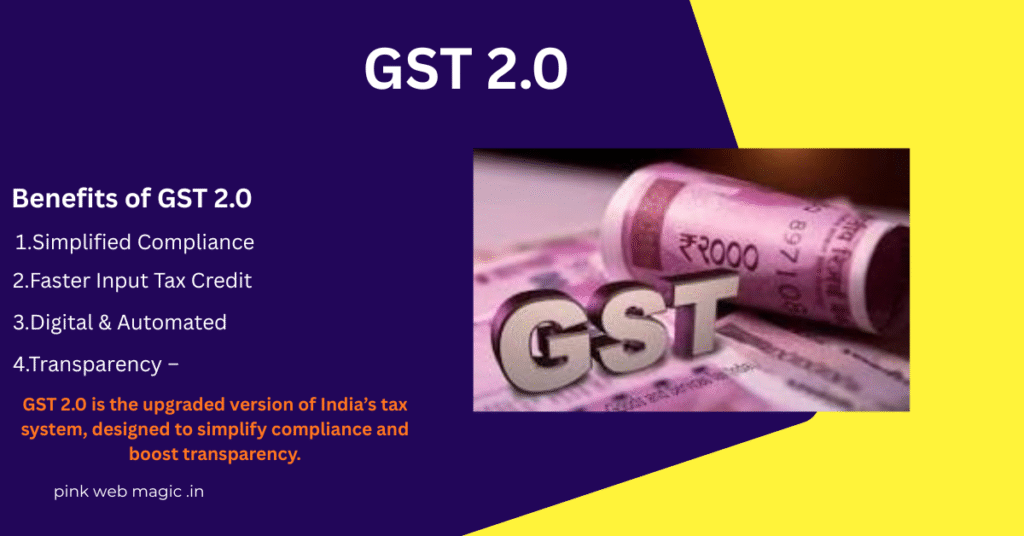
- Simplified Compliance – Businesses will find it easier to understand and follow tax regulations.
- Faster and Secure ITC – Improved cash flow and smoother business operations.
- Automation & Digital Platform – Reduced errors and faster processes.
- Transparency – Less tax evasion and better government monitoring.
- Business-friendly – Saves time and costs, helping businesses grow efficiently.
The Future with GST
GST is not just about simplifying current taxation; it is a step toward making India a leader in digital tax administration. By leveraging AI and data analytics, the system will continue to enhance accuracy, reduce errors, and make tax processes smarter.
Conclusion
GST represents a smart and digital transformation of India’s tax system. It simplifies taxation for businesses and taxpayers, ensures faster input tax credits, reduces compliance errors, and enhances transparency. With automation and digital tracking at its core, GST 2.0 promises to be beneficial for both businesses and the overall economy, streamlining processes and supporting growth.
GST 2.0: India’s Next-Level Tax Reform
Goods and Services Tax (GST) has been a game-changer for India’s taxation system since its implementation in 2017. Now, the government is introducing GST 2.0, aimed at making the tax system more efficient, transparent, and business-friendly. GST 2.0 focuses on automating processes, reducing compliance burden, and integrating technology for seamless tax administration.
One of the biggest changes in GST 2.0 is the implementation of AI and data analytics to monitor transactions. This ensures accurate reporting, reduces tax evasion, and allows real-time tracking of GST payments. The system also promotes auto-populated returns, which simplifies filing for businesses and minimizes human errors.
Another major feature is the enhanced taxpayer experience. GST 2.0 introduces a more user-friendly interface, faster processing of refunds, and improved grievance redressal mechanisms. Businesses can now access a unified portal for filing returns, tracking payments, and checking compliance, making tax management easier than ever before.
GST 2.0 also emphasizes compliance through technology. By leveraging e-invoicing, QR code-based verification, and advanced data analytics, the government aims to make tax evasion nearly impossible and reduce disputes. For small and medium enterprises (SMEs), this means less paperwork and a more transparent system.
In summary, GST 2.0 is not just an upgrade; it is a revolution in India’s taxation system. It benefits businesses with simplified compliance, faster refunds, and improved transparency while ensuring the government efficiently collects revenue. With GST 2.0, India moves closer to a fully digitized, accountable, and business-friendly tax ecosystem.

GST 2.0: India’s Next-Gen Tax Reform
India’s Goods and Services Tax (GST) has been a landmark reform since 2017, simplifying indirect taxation across the country. Now, with the introduction of GST 2.0, the government aims to make the system even more efficient, transparent, and business-friendly. GST 2.0 focuses on automation, digitalization, and minimizing compliance hurdles for taxpayers.
One of the key highlights of GST 2.0 is the auto-population of returns. This reduces manual effort, prevents errors, and speeds up the filing process for businesses. The system leverages advanced data analytics and AI to track transactions in real-time, helping the government curb tax evasion and ensure accurate tax collection.
GST 2.0 also emphasizes a better taxpayer experience. With a unified, user-friendly portal, businesses can easily file returns, claim refunds, and resolve grievances. The process is designed to be smooth for small and medium enterprises (SMEs), reducing paperwork and making compliance less stressful.
Another significant feature is enhanced technology integration. The new system supports e-invoicing, QR-code verification, and instant tax reconciliation. These changes not only improve transparency but also make auditing easier for authorities and reduce disputes between taxpayers and the government.
Overall, GST 2.0 represents a major step towards a fully digitized and efficient tax ecosystem in India. It simplifies compliance for businesses, ensures faster refunds, reduces human errors, and strengthens the overall taxation system. By combining technology and smart policy reforms, GST 2.0 aims to make indirect taxation more transparent, accountable, and hassle-free, benefiting both businesses and the government.
The primary goal of GST 2.0 is to simplify compliance for businesses. The system introduces auto-populated returns, reducing manual work and minimizing errors. Businesses will no longer have to spend excessive time reconciling invoices or filling multiple forms. This change is particularly beneficial for small and medium enterprises (SMEs), making tax filing easier and less time-consuming.
Another major improvement is the integration of technology and AI. GST 2.0 uses data analytics and artificial intelligence to track transactions in real-time. This helps in preventing tax evasion and ensures accurate tax collection. Advanced technology also allows for faster processing of refunds and smoother handling of disputes, which has been a common issue under the previous GST system.
GST 2.0 also focuses on a better taxpayer experience. A unified portal provides a single platform for filing returns, tracking payments, and resolving grievances. The user-friendly interface ensures that even those with minimal technical knowledge can navigate the system easily. Additionally, features like QR code-based verification and e-invoicing increase transparency and accountability, reducing the chances of errors and fraud.
For businesses, GST 2.0 is more than just a compliance tool. It is a step towards digital transformation, helping companies manage taxes efficiently while staying updated with government regulations. By reducing paperwork, automating processes, and leveraging technology, GST 2.0 ensures a smooth and hassle-free experience for taxpayers.
In conclusion, GST 2.0 is a game-changer for India’s taxation system. It strengthens transparency, reduces manual intervention, and simplifies compliance for businesses of all sizes. With faster refunds, digital integration, and a user-friendly system, GST 2.0 is setting a new benchmark for efficient and accountable tax administration in India.